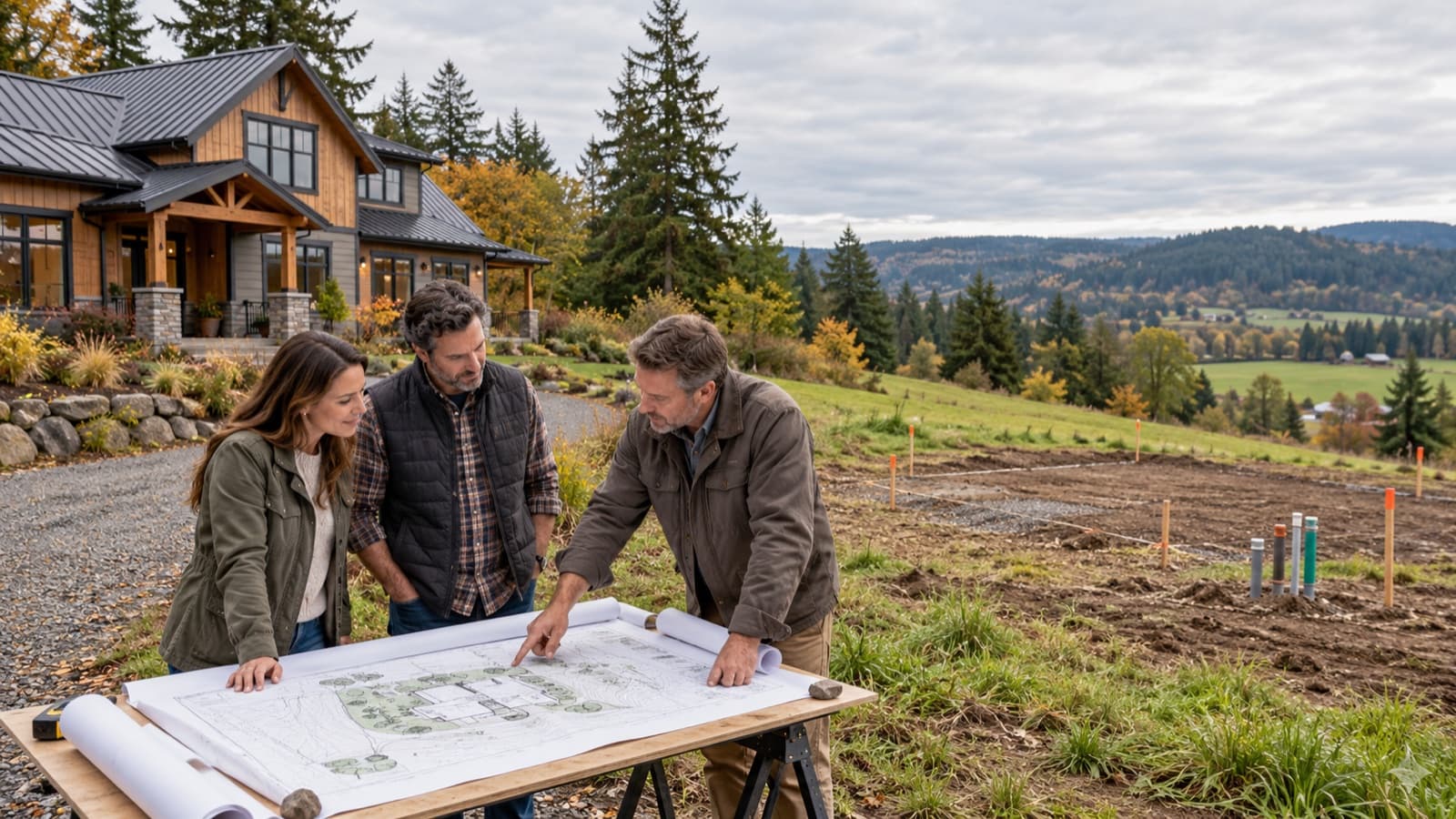
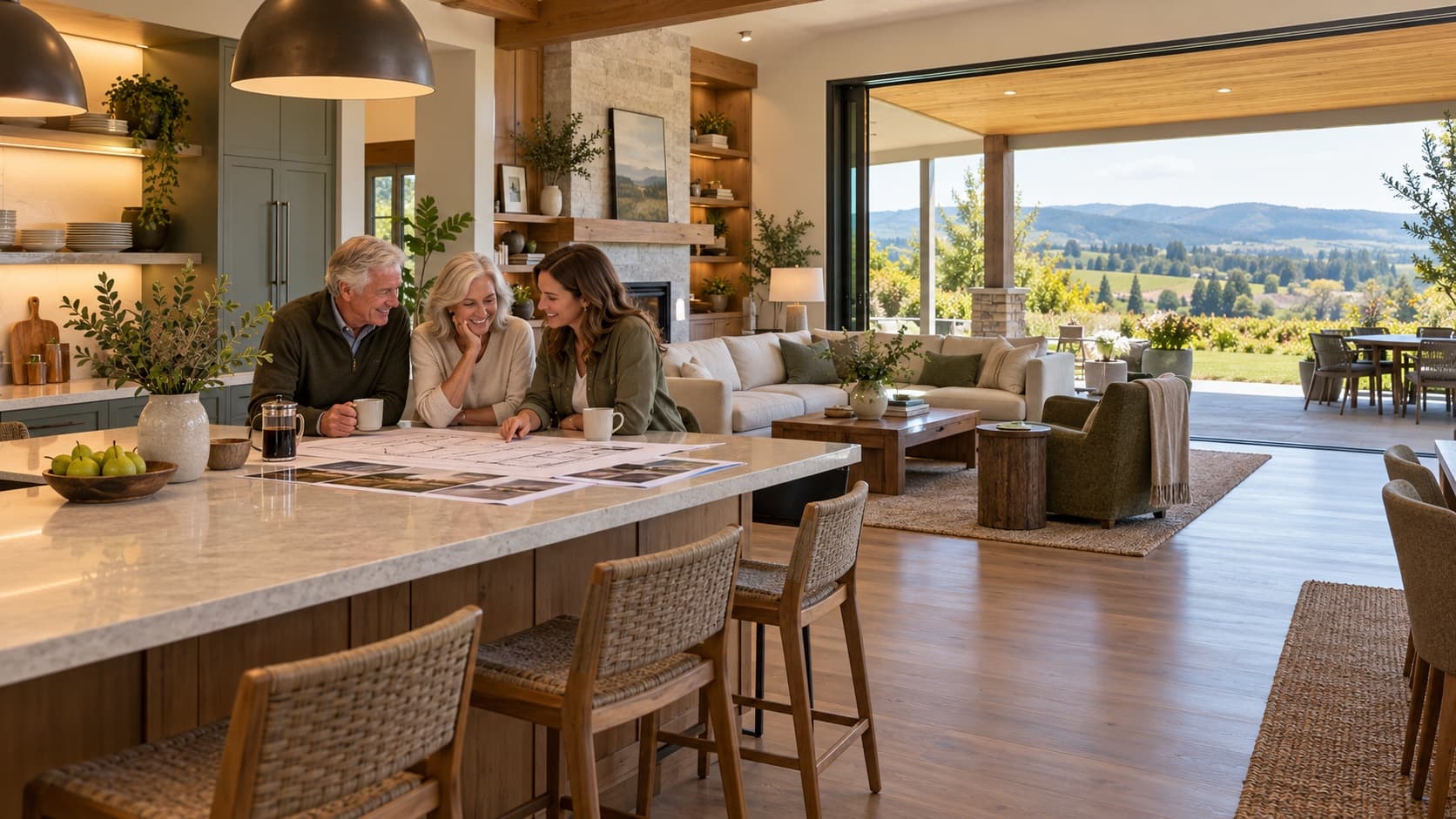
Before a custom home has a floor plan, it has a place.
That place quietly shapes almost every decision that follows: the commute, the view, the privacy, the permitting path, the site work, the budget risk, the neighbors, the driveway, the utilities, and the way daily life will feel once the home is finished.
In Northwest Oregon, many homeowners eventually face a version of the same question: should we build on an infill lot close to town, or should we look for a county parcel with more room, more quiet, and more view?
There is no universal right answer. There is only the right site for the life you are trying to build.
Why This Question Matters Right Now
Oregon is publicly pushing to increase housing production. In August 2026, the Governor's Office reported that Oregon housing starts were up 11.3% year over year in the first half of 2026, even while national production was down. Portland has also been working through housing-code updates and incentives intended to encourage more housing in existing neighborhoods.
That policy conversation often sounds large and abstract. Homeowners experience it much more personally.
They experience it when a small lot becomes available near work. They experience it when a rural parcel opens up with a view across the valley. They experience it when they realize the lot itself may determine whether the project feels efficient, peaceful, social, private, convenient, expensive, or complicated.
The choice between infill and county land is not just a real estate choice. It is a lifestyle and construction choice.
What Infill Really Means
An infill lot is typically a lot inside or near an existing neighborhood, city, or developed area. It may be a vacant lot between homes, a divided property, a redevelopment opportunity, or a small site where utilities, roads, services, and neighboring homes already exist nearby.
The main benefit is access.
Infill lots are often closer to work, schools, restaurants, medical care, groceries, public services, and everyday errands. For a homeowner who values commute time and access to local services, an infill lot can make daily life easier in a way that a beautiful rural parcel may not.
That convenience has real value. Less time driving can mean more time at home, more flexibility for family schedules, and a home that stays connected to the community around it.
If commute and access to local services matter most, look seriously at infill.
What a County Parcel Offers
A county parcel is usually outside the tighter city pattern. It may offer acreage, trees, pasture, slope, privacy, room for outbuildings, more separation from neighbors, and the quiet that many people picture when they imagine a custom home in Northwest Oregon.
This is where county land can be emotionally powerful.
A rural or county parcel may give you sunrise through fir trees, a view across a valley, a long driveway, space for gardens, room for children to explore, or the feeling that the day slows down when you get home.
For some homeowners, that is the whole point of building custom. They are not only trying to get a house. They are trying to create a place that feels like retreat.
If peace, room to grow, and country views matter most, a county parcel may be the place for you.
The Budget Difference Is Not Always Where People Expect
Many homeowners assume county land is automatically cheaper because the purchase price may look better per acre. Sometimes that is true when measured only by land area.
But land cost and build cost are not the same thing.
Infill lots are often more expensive per square foot or per acre because they are closer to existing services, employment, schools, and amenities. The land itself may feel costly for its size.
County parcels can look like a better land value, but they often carry more site-work uncertainty. Long driveways, grading, drainage, septic, wells, utility extensions, fire access, tree removal, retaining conditions, and rural road access can all change the real project cost.
That is why budget surprises are often less dramatic on a straightforward infill lot than on a county scattered-site parcel. The infill lot may cost more upfront for the land, but the site-work scope is often easier to define earlier. The county parcel may offer more land and beauty, but the unknowns can be larger.
Permitting Depends Heavily on the Jurisdiction
One of the biggest mistakes homeowners make is assuming permit timelines are consistent across Oregon.
They are not.
Oregon's Building Codes Division makes clear that most cities and counties provide their own plan review, permit, and inspection services, and that local permitting, zoning, land-use allowances, and alternate methods need to be discussed with the local jurisdiction. In practice, that means two similar homes in two different jurisdictions can move through review very differently.
Current local examples show the spread. Portland publishes permit timeline dashboards and review data. Washington County lists multiple steps such as prescreening, planning/site review, grading review, initial plan review, corrections, file check, and issuance. Benton County publishes typical and maximum processing ranges for different permit types, including separate ranges for one- and two-family dwellings, septic, and other permits. Deschutes County notes that not all residential permits require the same planning review and that timelines differ within city jurisdictions.
The practical takeaway is simple: do not build a custom-home schedule around a generic permit timeline. Build it around the actual jurisdiction, the actual site, and the actual review path.
Neighborhood Concerns Are Real on Infill Projects
Infill projects can be efficient from a land-use standpoint, but they happen close to other people.
That means neighborhood concerns can become a major hurdle. Neighbors may worry about parking, privacy, views, trees, construction noise, traffic, drainage, building height, or whether the new home fits the character of the area.
Plans and permits matter, but so does how people are treated.
Being personable helps a lot. Clear communication, reasonable construction behavior, clean jobsite habits, and respect for the surrounding homes can reduce friction. A neighbor may still disagree with the project, but people usually respond better when they feel seen rather than ignored.
For a homeowner, this is one of the hidden differences between infill and county land. Infill may offer a better commute and easier access to services, but the project is happening in the middle of an existing social setting. That has to be managed with care.
County Parcels Bring Different Questions
County parcels may have fewer immediate neighbors watching every step, but they often bring more site-specific questions.
- Can the driveway meet access and fire requirements?
- Where will the well, septic system, and reserve area go?
- How far do utilities need to be extended?
- What grading or drainage work is needed before the home can be built?
- Are there wetlands, slopes, trees, easements, or environmental overlays?
- Can construction equipment reach the home site safely and efficiently?
These questions do not mean a county parcel is a bad choice. They mean it needs serious site planning before the home design is treated as settled.
The danger is falling in love with the view, drawing the house, and only later discovering that the driveway, septic, grading, or utility plan changes the budget.
How to Choose Between the Two
The best choice starts with honesty about daily life.
If commute time, school proximity, city services, walkability, local restaurants, and practical access matter most, an infill lot may serve you better. The lot may cost more for its size, and neighbors may require more thoughtful communication, but daily convenience can be a major quality-of-life win.
If quiet, room to grow, privacy, gardens, workshops, animals, trees, and Northwest Oregon views matter most, a county parcel may be worth the added site-work investigation. The land may feel more spacious and peaceful, but the early planning needs to be deeper because the site itself can carry more budget risk.
A Practical Site Decision Checklist
- Decide what matters more: daily access or daily retreat.
- Ask the local jurisdiction about the actual review path before assuming a timeline.
- Study site-work scope early, especially utilities, driveway, grading, drainage, septic, and fire access.
- For infill lots, consider neighbor impacts and construction logistics before the design is finalized.
- For county parcels, price the land and the site work together, not separately.
- Build the plan around the property instead of forcing a generic plan onto the land.
The Site Should Shape the Design
A good custom home does not ignore its setting.
On an infill lot, the design may need to solve privacy, light, parking, massing, neighbor relationships, and efficient use of a smaller footprint. On a county parcel, the design may need to solve views, sun exposure, slope, driveway approach, utilities, weather exposure, and how the home sits in a larger landscape.
That is why Masterwork starts with planning before rushing into drawings that only look good on paper. The right design comes from understanding the land, the jurisdiction, the budget, and the life the homeowner wants to live there.
If you are choosing between an infill lot and a county parcel for a custom home in Oregon, the best next step is a site-informed project review. The lot is not just where the home goes. It is the first design decision.